About Me

PhD, NET(UGC), MBA (Finance), M.com (Finance), B.COM (professional), B.Ed (Commerce + English), DIM, PGDIM, PGDIFM, NIIT Accounting package...

Wednesday, February 19, 2020

GST suvida Provider GSP

Who is a GST Suvidha Provider (GSP)?

GSP stands for GST Suvidha Provider. A GSP enables a GST taxpayer to comply with all the procedural provisions of the GST law through its web platform. ClearTax, an online tax filing platform has been granted the status of GSP. A GSP provides innovative methods or means of an effective interactive platform for taxpayers to access GST portal services ranging from registration and invoicing to completion of GST return filing.
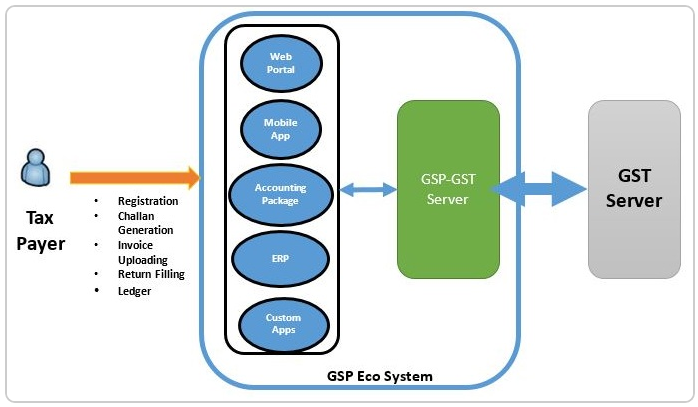
GSP Ecosystem
Image Courtesy: gstn.org

Understanding with an example:

Let’s take an example to understand it better:

ABC Ltd is a private multinational company, which is running operations on SAP ERP. All records with respect to purchases and sales are maintained in it. At the end of each month, reports are generated from ERP and utilised to prepare and generate tax returns. Thereafter, returns are uploaded on the government’s portal.

Our government is now aiming for single and automated workflow wherein these ERP companies can build an interface with government’s portal and all the GST related compliance can be done directly through their software.

GSP need not be only ERP companies but can be startups or financial technology companies having expertise in building web applications for filing GST returns such as ClearTax.

GSP – A Brainchild of Goods and Services Tax Network

GSP is a term coined by GSTN (Goods and Service Tax Network), the private non-government entity that owns and maintains the GST portal.

It is in-line with the ‘Digital India’ initiative that advocates a paperless tax compliance regime that enables transparency and reliability in doing business across India.

Three Modes of Interaction With GST portal


1) Filing directly on the GST portal

A GST taxpayer will usually access the website directly for availing various services offered on the website such as registration, GST return filing, refund application, and other similar GST compliances. However, for services such as GST return filing, a taxpayer may not be technically equipped to file online. Hence, they may find it difficult to collate sales and purchase data from his ERP system or accounting software in the required GSTN format. A lot of manual efforts may go into preparing the GST returns. Hence, a GST Suvidha Provider is an indirect means yet an easy platform to access the GST portal saving time and efforts.

Under indirect means, there are two types of intermediaries between the taxpayer and the GST portal. They are as follows:

2) ASP who is not a GSP:

These entities provide the requisite third-party applications for GST compliance. They have user interfaces via various modes such as desktop, mobile or any other interfaces for taxpayers just like any other Application Service Provider (ASP). Such an application developer can connect with the GST portal via a secure GST system Application Programming Interface (APIs) accessed with the help of GST Suvidha Providers.

The below diagram will show the two ways of how the taxpayers can access the GST portal indirectly through an ASP who is Non-GSP:
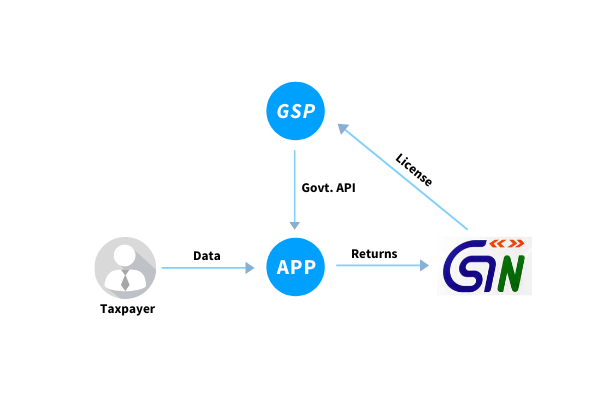
Interaction through ASP who is not a GSP

3) ASP who is also a GSP:

A government-approved application service provider is the most reliable mode of completing GST compliances. They provide the application and are also authorised to provide an interactive platform to access the GST portal. Such an ASP who is also a GST Suvidha Provider can connect seamlessly with the GST portal and helps avoid; any third-party dependency, thereby increasing the speed of processing of data. Also, an ASP which has access to multiple GSPs will ensure higher uptime availability and scalability for the user.

The below diagram will show the two ways of how the taxpayers can access the GST portal indirectly through an ASP who is also a GSP:

Interaction through an ASP who is also a GSP

Interaction of a taxpayer with the GST portal can, therefore, take place via either of the three routes as follows:
GSP
Overview of Interaction through GSP

Areas addressed by GST Suvidha Providers

  1. Upload invoice data (B2B and large value B2C).
  2. Upload GSTR-1 (return containing supply data), which will be created based on invoice data and some other data provided by the taxpayer.
  3. GSTR-2A download and reconciliationwith purchase data accounted on ERP.
  4. File GSTR-3B based on the GSTR-1 filed, purchase data on record and GSTR-2A information available.
  5. Similarly, there are other returns for other categories of taxpayers like casual taxpayer or composition taxpayers.

List of GSPs in India

Till November 2019, there have been three rounds of licensing for GST Suvidha Provider. In the first round of allotment of the license, thirty-four companies were granted GSP license. Read the 1st round of allottees here.
In the next round of licensing, around 42 companies were allotted the status of GSP as listed here.
In the latest round of GSP list announced in November 2019, 10 companies have joined the list as laid down here. ClearTax is a GSP authorised to connect to the GST Network using published APIs.

Benefits of being an ASP who is also a GSP

  1. Allows an end-to-end integration with any ERP system or accounting software so that data can be fetched automatically.
  2. Improved and faster performancecompared to any other ASP not being GST Suvidha Provider.
  3. The integration with the GSTN can allow a smooth flow of data between the application and the GST portal avoiding any third-party dependency.
  4. A single login is needed to accessdifferent locations (GSTIN) instead of login and logout each time from different locations.
  5. Better security ensured as all security standards are met and approved by GSTN.

https://cleartax.in

Tuesday, February 11, 2020

Corporate Tax planning book

https://www.studocu.com/en/document/guru-gobind-singh-indraprastha-university/bachelors-of-business-administration/lecture-notes/notes-on-corporate-tax-planning/3321270/view

Monday, February 3, 2020

Structure of the Garment Industry

Structure of the Garment Industry

INTRODUCTION 
Throughout its long history, the garment industry has always been characterized by change and variety, but never so much as today. During the past three decades or so this situation has undergone a complete turn-around and now the reverse is true. 

Today, fashion changes are dramatic and frequent; as a result the clothing procedure has to reconcile the conflicting requirements of the market and of his manufacturing facilities in order to stay in business. 

The basic needs of the market are:
  1. Garments with up-to-date fashion appeal;
  2. Low forward commitments in order to leave open options to exploit sudden demands during the season;
  3. Competitive prices;
  4. Acceptable quality standards;
  5. Quick response and short delivery times.
But to produce goods efficiently and profitably, the producer requires:
  1. A minimum of style and cloth variety;
  2. Large orders, well in advance of delivery dates;
  3. Adequate time for planning;
  4. Time to develop garment and method engineering for price sensitive and other critical types of merchandise;
  5. Reasonable level of work in progress.
The key to optimizing this conflict of interest’s lies in the ability of management to maximize the productivity of available resources. This can only be achieved by increasing the effectiveness of the operational performance levels of every department within the company; these performance levels determine success or failure. 

STRUCTURE OF THE CLOTHING INDUSTRY 

The structure of the clothing industry can be in different sectors, an industry is a huge systematic program which cannot explain in a short word, but we can explain the basic structural points of the clothing industry. 

The apparel industry supply chain starts from the farming of cotton in the cotton fields, manufacturing of man-made fibers to selling clothes in retail store to the consumers. Broadly the skeleton of the apparel supply chain consist of the following. 

SIZE STRUCTURE: 
Entry to the clothing industry has always been easy because of the relatively small amount of capital required to purchase machinery and the necessary raw materials. 

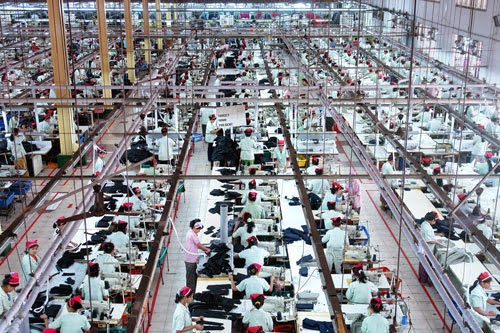
For the past century the industry has been dominated by one simple, cheap and long-leaved tool, the basic sewing machine, and this not only facilitates entry into the industry but virtually dictates its structure. This is amply demonstrated by the large number of small factories which exist within the industry.
Working space of a garment industry
MANUFACTURING STRUCTURE: 
The clothing industry manufactures a vast variety of garment types ranging from work clothes to ball gowns and the production itself can be carried out by one of two types of organization: a manufacturer or a sub-contractor. 

Apparel manufacturers: Marketing, merchandising, and production. Apparel production is categorized in two types.
  1. Perform manufacturing within own facilities and employees.
  2. Contact some or all of the manufacturing functions to other firms. Contracting even categorized in 3 sub category. These are like -
  • Cut-make-trim (CMT) contactors:supply operators, machines, and thread and make garments.
  • Full package program (FPP): source materials and develop patterns as well as make garments. Greater financial responsibility. FPP might higher CMT contractors.
  • Specialty contractors: provide services such as pattern grading, cutting, embroidering, belt making, fabric pleating, or screen printing.
SUB-CONTRACTOR: 
These account for most of the small factories within the clothing industry and they exist because they produce garments of acceptable quality at competitive price in a short through put time. The contractor’s prices must not only be competitive with those of other sub-contractor, but they must also be low enough to make it attractive for the manufacturer. 

The strength of the sub-contractor is in factory management and the maintenance of very low overhead. In addition he must:
  1. Maintain continuity of production;
  2. Ensure that his customers are reputable and financially secure;
  3. Recognize and select the most profitable opportunities;
  4. Obtain high productivity levels from his labour force;
  5. Utilizes to the fullest all the materials supplied by the manufacturer.
As an individual, the sub-contractor will perform nearly all the management and administrative functions within the factory and will also regularly visits the manufacturers supplying work to the unit. 

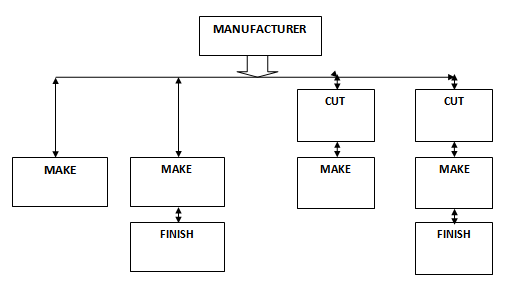
Working method: the manufacturer can produce garments via a sub-contractor in a number of ways, for example: 

1. Cutting: 
The manufacturer can supply the sub-contractor with 
  • 1.Cut garments ready for sewing;
  • 1.Raw materials and cutting markers;
  • 1.Raw materials and graded sets of patterns.
2. Making-up: 
This is the raison-d’être of the sub-contractor and the basic service he sells. 

3. Trimmings: 
The manufacturers can supply all, some or none of the trimmings required to make the garments. 

4. Finishing: 
This usually refers to pressing, final inspection and bagging, and one or more of these process can be performed by the manufacturer or the sub-contractor. 

5. Quality control: 
The manufacturer usually operates in process and final quality control procedures to ensure that garments produced bby the sub-contractor are according to specification. 
Manufacturer and Sub-contractor
RETAILING LEVEL: 
Retailing means selling clothing to the consumer. Apparel manufacturers may be forward vertically integrated into the retail sector through owning their own stores.  
 
Retailing format: there is seven different format of garment retailing as following, 
  • Catalog retailers (Examples: Land's End, L.L. Beans).
  • Department store retailers (Examples: Dillard’s, Macy’s).
  • Internet retailers
  • Mass retailers: offer consumer goods in a discount with self service environment (Examples: Wal-mart, Target, and J.C. Penney).
  • Specialty retailers: offer a large selection of a limited line of consumer goods with narrow target customers (Examples: Victoria’s Secret, Nordstrom).
  • Ware house/wholesale clubs (Examples: Costco, Sam’s Club, BJ’s).
  • Retailer outlets: clearance centers of the previous season’s and year’s.
Retailers use multiple channels of distribution and channel integration.

Example: Department store + Web sites+ Catalog distribution. 

CONSUMER:
Decisions at all levels are based on forecasts of customer demand. 

TO SUM UP: 
Technology has dramatically altered the apparel industry, but the need to source textiles, trims and findings for manufacture into garments that fit the consumer's budget keeps the basic structure of the industry intact, and offshore manufacturing has contributed to maintaining low retail prices. Technology allows global expansion because a designer in New York can easily communicate with mills and manufacturing facilities in other countries, sending graphics and design specifications instantly via the Internet. 

So we can utilize the advancement of the technology for the better result from our clothing industry, and grown up the skills of our employee day by day. And this easy but smarter way can make us best from better. 

https://textilelearner.blogspot.com/2014/10/structure-of-garment-industry.html?m=1#google_vignette

Different Departments in Garment Industry

Different Departments in Garment Industry

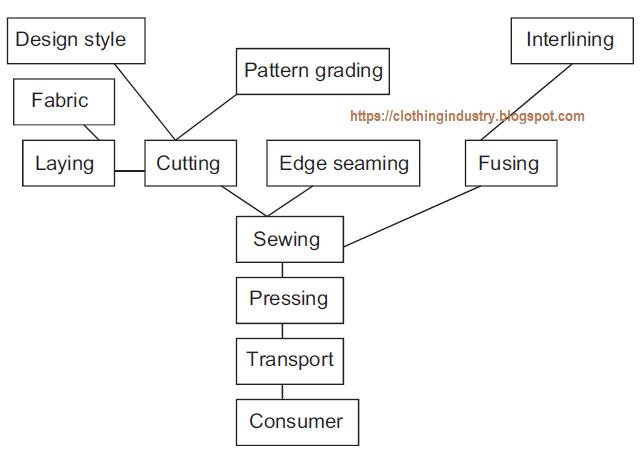
Garment technology is a broad based subject because it combines a number of individual technologies, with each making a specialized contribution to the production of garment. The apparel industry is very diverse in nature and along with textile industries, it forms a complex combination of performing heterogeneous functions of transforming fiber into yarn and then to fabric. It is one of the oldest and largest industry providing ample employment opportunities and it exemplifies the growth in global manufacturing. This industry is very versatile in nature and offers the world with a choice of garments ranging from mass market to high end fashion. This industry follows a combination of functional and line type of organization. Garment manufacturing process includes number of processes from order receiving to dispatching shipment of the finished garments. Apparel manufacturing flow chart helps understand a garment manufacturing method that how the raw materials are converted into the wearable garments. The main task for a garment manufacturer is to produce shell structures out of flat fabrics to match the shape of human body. The overall flowchart of the garment manufacturing process is illustrated in figure-1.
flowchart of the garment manufacturing process
Figure-1: Flowchart of the garment manufacturing process
Apparel or garment industry is the final stage of textile manufacturing where cloth is cut into different parts and sews to make various types of apparel. All the process of garment manufacturing are done in different sections in garment industry. In this article I will discuss various departments in apparel manufacturing industry. 

Various Departments in the Apparel Industry: 
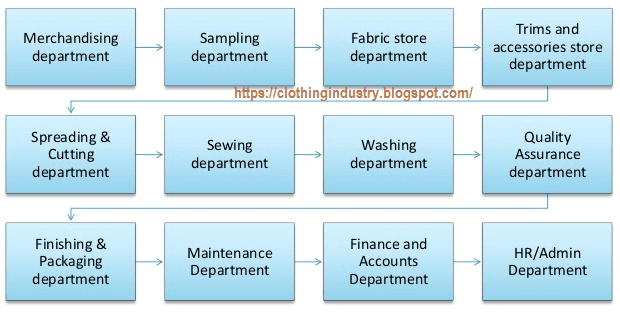
Clothing or apparel industry consists of different departments. Every department is responsible for better production. The various departments working flowchart are given in figure-2: 

Various garment departments working flowchart
Figure-2: Various garment departments working flowchart
We will discus of the different departments or sections in an apparel industry are given below:
  1. Merchandising
  2. Sampling department
  3. Fabric sourcing
  4. Purchasing department
  5. Fabric inspection department
  6. Accessory stores department
  7. Planning department
  8. Laboratory department
  9. Machine maintenance
  10. CAD section
  11. Cutting section
  12. Production department
  13. Industrial engineering section (IE)
  14. Embroidery department
  15. Fabric washing section
  16. Quality assurance department
  17. Finishing department
Function of the Different Departments in Apparel Industry: 
Functions of the all sections of garment manufacturing industry are described briefly: 


Merchandising: 
It is a vital process that involves planning, developing, executing and dispatching the order (product) to the buyer. The merchandising process comprises guiding and supervising for the successful processing of an order. The types of merchandising done in a garment unit are marketing merchandising and product merchandising. 

The main objective of marketing merchandising is development of product, costing and ordering, and it has direct contact with the buyer. Product merchandising is carried out in the respective apparel unit and involves all the responsibilities starting from sourcing to finishing. 

Sampling department: 
The sampling department coordinates with the merchandising and production department. It is carried out to foresee finished product appearance and fit when produced in bulk and to confirm whether there are any inconsistencies in the pattern according to the buyer’s specification. It also aids to determine the fabric consumption along with that of thread and other accessories used. 

Fabric sourcing: 
Fabric sourcing is mainly engaged in deciding where and how the fabrics have to be procured. It works in conjunction with the merchandising department and looks after the delivery of the required garments within the scheduled time and cost. 

Purchasing department: 
The main difference between the sourcing and purchasing department is that the sourcing section works for sourcing the fabrics alone whereas the nature of the work of the purchasing department comprises sourcing of accessories and trims as well. 

Fabric inspection department: 
The main aims of fabric inspection team are 

  1. Identification and analysis of fabric defects using various standard methods.
  2. Selection of fabric according to AQL (accepted quality level)1.5.
Accessory stores department: 
The receipt of the raw materials or the accessories is normally completed in terms of documents that are received from the merchants. 

Production planning department: 
Upon receipt of the orders from the merchants, preproduction meetings with the departments have to be done. After that, the production department will assign the style to the specific line that has the capacity to complete it on time. The planning section then carries out the estimation and planning of order quantity, plan cut date (PCD), breakup of order, operation breakdown, etc. based on the particular unit. 

Laboratory department: 
The laboratory or testing centre in the industry should be equipped with all the essential instruments that are mandatory for the testing of fabric and accessories. If the facility for specific tests mentioned by the buyer is not available in the industry, it should be sent to external laboratories that are authorised by the buyers. 

Machine maintenance: 
Undesirable quality of garments mostly results from ill-maintained machines. Breakdown and preventive maintenance is mainly aimed toward reducing the downtime and increasing lifetime, respectively. 

CAD section: 
Normally, large-scale garment industries have their own designing department for various garment styles. The CAD department is accountable for the following functions:
  • Determining cutting average for costing
  • Making the most efficient cutting marker
  • Development and alteration of patterns
  • Development of size set pattern by grading
  • Digitising the pattern
Cutting section: 
The cutting department normally receives the order from the production manager who has approved the cutting order to cut a given quantity of garment styles. The cutting order sheet contains the following information:
  • Sampling average, garment weight and averages of other trims
  • Measurement sheet
  • Design of the garment
  • Purchase order
  • Fabric request sheet
  • Marker planning – length of lay, etc., size ratio and colours in which the patterns are to be cut
Production department: 
The production department will obtain the details like
  • The garment style
  • Number of operators required
  • The batch for which the style has to be installed
  • Target for each day
  • Breakup of the production quantity
After receipt of all of the above details, the production department sends a request from the cutting section for the cut parts. After assembling of the components, a line check has to be done where the shade matching and the measurements are checked. 

Industrial engineering section: 
This department is comparatively new addition in apparel industry. It coordinates with several departments since this department provides the entire plan of the garment manufacturing and the thread and trims consumption criteria, operator’s skill level categorisation and other related aspects. 

Embroidery department: 
It comes into play only when the particular garment style demands. It receives the garment panel, style and the embroidery details from the merchandisers and they will also get a sample of the garment on which the embroidery has been already done and it will be used as a reference sample. 

Fabric washing section: 
After the completion of assembling and inspection process, the garments are sent to the washing department for the washing or finishing that is required for the particular style according to the specification sheet. 

Quality assurance department: 
To maintain and control the quality, the quality assurance department divides the work into different stages of manufacturing, which are categorised into three major groups such as preproduction unit, cutting audit and sewing unit. 

Finishing department: 
The finishing department is the last section in the garment production prior to packing and dispatch and it plays a significant role in the final garment appearance. It involves the following processes.
  1. Trimming: It removes the extra threads from the garment at the stitched areas.
  2. Inspection: The inspection is done as per the AQL 2.5 system and mainly depends on the buyer requirements.
  3. Pressing: This is carried out after the garment has been inspected completely and the garments are pressed or finished based on the method of their folding during packing.
  4. Tagging section: After the completion of fabric inspection and pressing, they are sent for labelling, which includes the size labels, price tags and miscellaneous labels if any are mentioned in the specification sheet.
  5. Packing: The packing is done in the carton boxes. Individual packing of garments in the poly bag and folding the garments and organizing them in the carton boxes without placing them in the poly bag are the two types of packing followed in the garment industry.
https://clothingindustry.blogspot.com/2017/11/departments-garment-industry.html?m=1

Sunday, February 2, 2020

Role and responsibilities of retail fashion business

People engaged in the retail clothing industry are involved with buying products, merchandising them and selling them to customers. Retailers often learn to market their products effectively through such techniques as print and electronic advertising. Managing the sales staff and servicing customers are also important duties in the retail clothing industry.

Visual Merchandising

Designing and setting up commercial displays to encourage buyers is an important duty in the retail clothing industry. Window dressers and merchandise displayers design eye-catching exhibits to attract the attention of buyers. Retailers who participate in trade shows also need to use visual merchandising to attract customers.

Marketing

Individuals in the retail clothing industry often market their products through print advertising. Owners and managers may be involved in deciding on marketing strategies and setting the marketing budget. Print advertising in the form of newspaper and magazine advertisements as well as direct mail postcards to announce sales and promotions are also used.Managing Staff

Store management plays a key role in the clothing industry. Retail store managers hire and oversee store personnel. Positions in a retail store can include sales people and cashiers as well as part-time or on-call IT experts and bookkeepers. The manager ensures that individuals are trained for their positions and that they perform their jobs well. He or she may evaluate job performance regularly and handle the payroll by matching the number of hours to the paycheck for each employee.

Inventory Control

The retail clothing store manager or owner may be in charge of inventory control. This means that there must be a system in place to reveal when more goods need to be ordered. The manager's duties include making sure orders are in on time, paying for the order and keeping track of how much is spent to secure more merchandise for sale.

Customer Service

Retail clothing managers and owners provide customer service to handle complaints and problems as they arise. How the buyer experiences customer service can mean the difference between a satisfied repeat customer and an irate customer who takes her business elsewhere.

AUDIT PLANNING: MEANING, OBJECTIVES, AND IMPORTANCE

📘 AUDIT PLANNING: MEANING, OBJECTIVES, AND IMPORTANCE ✅ Meaning of Audit Planning Audit Planning is the process of developing a compre...