About Me

PhD, NET(UGC), MBA (Finance), M.com (Finance), B.COM (professional), B.Ed (Commerce + English), DIM, PGDIM, PGDIFM, NIIT Accounting package...

Wednesday, September 23, 2020

valuation of rent free house


The term accommodation includes the following:

1. A flat,

2. Farm House or part thereof

3. Hotel

4. Guest House

5. Service apartment

6. Caravan

7. Mobile home

8. Ship or other floating structures

Employees are divided in the following two categories:

1. Central and State Government employees

2. Private sector employees or other employees

What is the type of rent free accommodation?

1. Furnished rent free accommodation

2. Unfurnished rent free accommodation

Taxability of Rent Free Accommodation

A] Value of Furnished rent free accommodation

Value of Unfurnished accommodation

Plus: 10% per annum of cost of furniture, if the furniture is owned by owned by the employer or actual rent of furniture

B] Value of Unfurnished rent free accommodation

i) Central and State Government employees

License fee of House determined will be taxable

ii) Private sector employees or other employees

a) If it is owned by employer

    • City having population upto 10 lakhs as per 2001 census – 5% of Salary
    • City having population exceeding 10 lakhs but upto 25 lakhs as per 2001 census – 10% of Salary
    • City having population exceeding 25 lakhs as per 2001 census – 15% of Salary

b) If taken on leased by employer

    • Actual lease rent paid by employer
    • 15% of Salary

Whichever is less will be taxable

Taxability for Hotel Accommodation

a) If Hotel Accommodation is unfurnished

It is not taxable

b) If Hotel Accommodation is furnished

  • Actual charges paid or payable for such hotel
  • 24% of the salary

Whichever is less will be taxable

Note: If the hotel accommodation is provided for not more than 15 days on transfer of employee from one place to another then it will not be taxable.

What is Salary includes for purpose of Taxability of Rent free accommodation?

Salary includes all emoluments paid to an employee but excludes dearness allowance which is not included in the computation for retirement benefits, allowance which are exempt from tax, value of perquisites under section 17(2), employer’s contribution to PF and lump sum payments received on retirement.

Valuation of Rent Free unfurnished accomodationLet me provide you with an illustration to explain this concept clearly –

Let us take the case of Mr. Narayan, an employee of X Pvt. Ltd, posted at Ajmer (population: 18 lakh), drawing Rs. 3,00,000/- as basic salary, Rs. 10,000/- as dearness allowance which forms part of salary for all retirement benefits and Rs. 5,000/- as commission. The company also provides him with a rent free unfurnished accommodation in Ajmer. The house is owned by the company. Fair rent of the accommodation is Rs. 55,000/- per annum.

In this case the value of the perquisite in respect of rent free accommodation owned by the employer depends upon the salary of the employee. Salary for this purpose of computation of the perquisite value works out to be Rs. 3,15,000/- i.e. Rs. 3,00,000 + Rs. 10,000 + Rs. 5,000. Fair rent of the accommodation is not taken into consideration. As the accommodation is situated in a city having a population exceeding 10 lakh but not exceeding 25 lakh, 10% of the salary i.e. Rs. 31,500 is the taxable value of the perquisite.

Monday, September 21, 2020

Instruments of Commercial Policy

Instruments of Commercial Policy

  1. Tariff

A tariff is a tax or duty levied on the traded commodity as it crosses a national boundary. An import tariff is a duty on the imported commodity, while an export tariff is a duty on the exported commodity.

Tariffs can be ad valorem, specific, or compound. The ad valorem tariff is expressed as a fixed percentage of the value of the traded commodity.

The specific tariff is expressed as a fixed sum per physical unit of the traded commodity. Finally, a compound tariff is a combination of an ad valorem and a specific tariff.

  1. Quotas

An import quota is a direct restriction on the quantity of some good that may be imported. The restriction is usually enforced by issuing licenses to some groups of individuals or firms.

For example, the United States has a quota on imports of foreign cheese.

The only firms allowed to import cheese are certain trading companies, each of which is allocated the right to import a maximum number of pounds of cheese each year.

Ad by Valueimpression
  1. Export Subsidies

An export subsidy is a payment to a firm or individual that ships a good abroad.

  1. Voluntary Export Restraint

Voluntary export restraint refers to the case where an importing country induces another nation to reduce its exports of a commodity “voluntarily,” under the threat of higher-all round trade restriction when these exports threaten an entire domestic industry.

The United States negotiated voluntary export restraint on Japanese automobile exports in 1981.

  1. Local Content Requirements

A local content requirement is a regulation that requires that some specified fraction of a final good be produced domestically.

  1. Export Credit Subsidies

This is like an export subsidy except that it takes the form of a subsidized loan to the buyer. The United States has a government institution, the Export-Import Bank, that is devoted to providing at least slightly subsidized loans to aid exports.

  1. Red-tape Barriers

Sometimes a government wants to restrict imports without doing so formally. It is easy to twist normal health, safety, and customs procedures to place substantial obstacles in the way of trade.

The classic example is the French decree in 1982 that all Japanese videocassette recorders must pass through the tiny customs house at Poitiers- effectively limiting the actual imports to a handful.

  1. Exchange Control

Exchange control refers to the restrictions on the purchase and sale of foreign exchange. It is operated in various forms by many countries, in particular tho$e who experience shortages of hard currencies.

A government can use exchange controls to limit the number of products that importers can purchase with a particular currency. For example, in 1985, China placed strict restrictions on foreign exchange spending.

What is Commercial Policy? Instruments of Commercial Policy

Commercial policy or trade policy is a governmental policy governing trade with other countries. This covers tariffs, trade subsidies, import quotas, voluntary export restraints, and restrictions on the establishment of foreign-owned businesses, regulation of trade in service, and other barriers to international trade.

Ad by Valueimpression

Countries that are part of an economic union often have a single commercial policy that determines how member countries can interact with non-member countries.

For example, member countries of the European Union have a common commercial policy.

Ad by Valueimpression

In modern times, the commercial policy of every country is generally based on the encouragement of exports and the discouragement of imports. The exports are encouraged by giving preferential freight rates on exports, subsidies, etc. Imports are hindered by erecting the tariffs walls, exchange controls, quota system, buy at the home campaign, etc.

Features/ Objectives of Commercial Policies

  1. To improve & extend international aid/co-operation through the exchange of goods & making a contract with different countries.
  2. To create an international market for our local products to increase export.
  3. To participate in the international trade fair to introduce our local products through govt or private initiatives.
  4. To take proper steps for promoting the export of non-traditional items.
  5. To launch publicity campaigns for creating a new market for traditional products.
  6. To create a favorable environment for foreign trade/exchange.
  7. To provide export facilities to exporters.
  8. To reduce the import of luxurious goods.
  9. To import raw materials, machinery, parts & accessories necessary for producing goods.
  10. To promote the establishment of export-oriented industries.
  11. To meet the need for essential goods.
  12. To encourage govt. & private sector industry for foreign trade.
  13. To stabilize the foreign exchange rate.
  14. To promote the export of man-power, to increase the earning of foreign currencies.
  15. Encourage domestic and foreign investment in overall industrial development.
  16. Encourage especially the development of small & cottage industries.
  17. Encourage the development of agro-based and agro-supportive industries.
  18. Stimulate the development of industries based on indigenous raw materials and indigenous technology
  19. Motivate investment in the intermediate and basic industries
  20. Create possible opportunities for revitalizing and rehabilitating controlling the quality of products; and
  21. Take appropriate measures for preventing environmental pollution and maintaining the ecological balance.
  22. Control the internal/external trade and other commercial activities of the economy

Tuesday, September 8, 2020

McClelland Theory of Need – Achievement, Affiliation, Power

 McClelland Theory of Need also known as three needs theory or the Learned Needs Theory.. The theory proposed that an individual’s specific needs are acquired over time and are shaped by one’s life experiences. McClelland did not differentiate between any certain transition among the needs. He indicates that some people have higher levels of one need than others.

McClelland Theory of Need

McClelland Theory of Need – Three Needs

These needs are classified as:

  1. Achievement
  2. Affiliation
  3. Power

Need for Achievement

People with a high need for achievement (nAch) seek to excel and thus tend to avoid both low-risk and high-risk situations. Achievers avoid low-risk situations because the easily attained success is not a genuine achievement. In high-risk projects, achievers see the outcome as one of chance rather than one’s own effort. They seek personal responsibility for finding solutions to problems. They need rapid feedback on their performance.

Need for Affiliation

Those with a high need for affiliation (nAff) need harmonious relationships with other people and need to feel accepted by other people. They tend to conform to the norms of their work group. High nAff individuals prefer work that provides significant personal interaction. They perform well in customer service and client interaction situations. They prefer cooperation over competition. They strive to make and keep relationships with a high amount of trust and mutual understanding.

Need for Power

A person’s need for power (nPow) can be one of two types – personal and institutional. Those who need personal power want to direct others, and this need often is perceived as undesirable. Persons who need institutional power (also known as social power) want to organise the efforts of others to further the goals of the organisation. Managers with a high need for institutional power tend to be more effective than those with a high need for personal power


https://www.papertyari.com/general-awareness/management/mcclelland-theory-of-need/

Adams’ Equity Theory

 Adams’ Equity Theory


Adams’ Equity Theory

Everyone wants to be treated fairly. No matter what avenue of life is in question, fair treatment is something that everyone appreciates – and demands. For a business owner or manager, this is a particularly important lesson to learn with regard to employees. If you aren’t treating your employees fairly, they are not going to be happy. That unhappiness can manifest itself in a number of ways. For one thing, you might not get their best effort on a daily basis. Also, you might struggle with high turnover rates as the good employees leave for better opportunities. If your organization is going to thrive into the future, fair treatment for all involved is essential.

It is this concept of fair treatment which is the basis for Adams’ Equity Theory. While this theory was developed more than 50 years ago, it remains very much relevant today. Every business owner or manager should have a clear understanding of the Equity Theory and how it can help to create a business structure which encourages employees to give their best effort day after day.

Inputs and Outputs

At the core of this theory is the idea that employee inputs and outputs need to match up as closely as possible. In other words, what an employee brings to the organization should be relatively equal to what that employee takes from the organization. We will get into more specifics on types of inputs and outputs later, but obviously the main output here is salary. In exchange for a salary, the employee is going to bring things like knowledge, experience, reliability, and much more. Should the inputs be worth more than the outputs, the employee is likely to be unhappy and problems will be sure to surface down the road.

What Is an Input?

In this case, an input is anything that an employee brings to an organization. There are potentially infinite examples of what kind of input can be provided by an employee, depending on the job at hand. To start with, you have the effort the employee puts in each day. They are giving a certain amount of their daily energy to the business, in return for whatever outputs are being offered. Effort can also be classified as hard work, and even commitment. No matter what you call it, the base level of effort offered by an employee is a notable piece of their overall input.

Another common input is skill or ability. For a skilled position – such as a job where the individual needs to be trained in a specific trade – the experience and knowledge they bring with them to the job is a valuable input. This input has notable value because it may not be easily replaced. If the employee has a relatively rare skill, that skill will be worth more to the company than a skill which is possessed by a large percentage of the work force.

Finally, one other input category to consider is the social skills and personal sacrifice offered by the employee to the organization. Is this individual willing to sacrifice themselves in some way – staying late, not getting the credit they deserve, etc. – in order to make the company better? If so, they are adding another input there as well.

What Is an Output?

It was mentioned earlier that the main output offered by an organization in exchange for an employee’s inputs is a salary. This is usually a set amount of money which will move from the company to the employee each month, but it may also be a commission-based compensation model. Whatever the case, it is certain that most employees consider this output first and foremost when weighing a job opportunity.

However, there are more outputs to take into consideration than just salary (and other financial benefits). For one thing, there is recognition within a specific field. For instance, if a company allows the individual to take much of the credit for what they accomplish, the recognition that comes from those accomplishments could lead to other job opportunities down the line. In this way, an employee could appreciate the way he or she is being given a chance to grow their reputation within a given field.

Another output which is important to consider is simply the sense of achievement that comes along with a job well done. If you present your employees with interesting and important challenges, they are likely to take pride in checking them off successfully. Some employees will be more rewarded by this point than others, but nearly everyone takes some degree of pride and ownership in their work.

Finding the Balance

The inherent challenge for any business owner or manager is the fact that many of these items don’t have clear financial values. For example, how much is someone’s hard work worth in terms of salary? Or, how much weight should be given to the fact that someone may get personal satisfaction for doing their job well? It is hard to balance out all of the various factors in order to come up with a compensation package that is fair to all involved.

In reality, finding equity for your employees is always going to be a moving target. This will always be something that you have to work at, and the job will never be done. Since different employees are going to bring different levels of effort and skill to the job, they will deserve different levels of compensation – and they will value different kinds of outputs in their own way. There is no one-size-fits-all approach here, so it will always be the job of the business owner or manager to play the game and come up with the right plan. To succeed on this point, it is important to keep Adams’ Equity Theory in mind. As long as you are trying to stay within a fair range when compensating your employees, the inputs and the outputs should be close enough to keep everyone happy.


for more visit

http://www.free-management-ebooks.com/news/adams-equity-theory/

Monday, September 7, 2020

Stages in the evolution of business


Stages in the evolution of business


Evolution of business means its origin, growth, and continuous development with expansion in various sectors, that contribute and run economies.

The business evolution went through many progressive stages or so called developmental steps. In each stage of progress, it evolved itself and got more mature than its previous state. It is evident that, at every step of evolution; it expanded its scale of operations and also widened its modes of communication. It is continuously evolving since then.

The five main stages in the evolution of a business are depicted below.

evolution of business

Image credits © Gaurav Akrani.

The business evolution went from local stage to a global one:

  1. First, the local business evolved from its three basic sub-stages,
    1. starting with a barter economy,
    2. then followed by the village economy and
    3. the town's economy.
  2. Secondly, the regional business grew as a result of cooperation between different states.
  3. Thirdly, the national business was an outcome of a business presence felt in the entire country.
  4. Then, international business emerged as an answer to fulfill the scarcity of resources felt within each country.
  5. Finally, an idea to see the entire world as one huge market was realized. This paved the way to form a new concept called global business.

Now let's discuss in brief each of the above-mentioned main stages that contributed towards the evolution of business.


Stage 1. Local Business


Local business is the starting stage of the evolution of business.

Business had its origin since the early ages of human civilization. It began with a mere sharing of food commodities. People use to collect and store whatever surplus they had and use to seek out something they didn't have. This situation was present in various areas around the world which later gave birth to a form of business in local areas.

The local area comprise of surrounding neighborhoods, adjacent areas where community of native people, mostly dwells, live, and remains active regularly.

In general, local business can be stated as various exchanges (trade) activities happening regularly among people of a local-area.

The three sub-stages of evolution of local business:

evolution of local business

Image credits © Gaurav Akrani.

  1. Barter economy stage:
    1. In barter economy stage, money is not used as a medium of exchange. Here, goods are exchanged for goods.
    2. Monetary transactions are absent in barter exchange.
    3. Here, the rate of exchange depends upon needs of both parties involved in a barter transaction.
    4. It is the barter system of trade that laid the very foundation of a business.
  2. Village economy stage:
    1. The village is a self-sufficient communal unit. Here, people usually live in harmony with each other and their environment by forming different cooperative social groups.
    2. The village economy is mainly supported and fueled by various agricultural activities.
    3. Here, people satisfy each other’s requirement by trading among themselves, their basic goods and services. However, in some special cases, even gold, silver, and copper are used for trading.
    4. When villagers started doing their businesses at a village level, it helped to form the world’s first markets.
    5. In these small markets, the villagers exchanged or sold their surplus goods.
    6. This overall helps to transcend the economy from a barter stage to become a village economy.
  3. Town economy stage:
    1. Town is a meeting ground for the majority of villages.
    2. It is a place where people from different villages come together, interact and mingle.
    3. This heterogeneous interaction brings the influx of new cultures and traditions, ideas, and creates better opportunities.
    4. This attracts many new people, and development also start taking place to sustain the demands of incoming masses.
    5. This process gradually results in the formation of the town's economy.

Stage 2. Regional Business


Regional business is the second stage of evolution of business.

In the context of this article, region is a huge landmass or an area that comprises of numerous town economies.

When a business alliance of a town's economy from any specific region feels the need to extend the scope of their business, it results in business expansion at a regional level.

The meaning of regional business:

  1. It is a business between different areas within a country.
  2. It mainly includes the trade between various states, which are political divisions that make up a country.
  3. Here, credit sales get more importance.
  4. Better and economic infrastructure facilities, especially, transport and communication are required to develop it.

Stage 3. National Business


National business is the third stage of evolution of business.

Nation is an organized political union of its member states.

The meaning of national business:

  1. It is present in the entire country. In a practical sense, it is spread in the most parts of a country.
  2. The business at a national level first started in England during the era of the Industrial Revolution. The joint-stock companies became very popular during this stage.
  3. The size of it is always large when compared with the business done at a regional level.
  4. It helps to make the availability of goods and services in the most parts of a country.

Stage 4. International Business


International business is the fourth stage of the evolution of business.

No nation is 100% self-sufficient with its all available resources. A nation may have an abundance of some resources but may also experience scarcity of other resources. To overcome this scarcity, nations often trade among themselves. They satisfy each other's needs by supplying their surpluses and/or expertise, and in return bring home, the scanty resources.

The meaning of international business:

  1. It implies businesses conducted among or between different nations. Here, two or more countries do business with each other. It mainly consists of imports and exports. For example, crude oil-rich Gulf countries export their raw oil and in return import the scare food items.
  2. This business is not a phenomenon of modern times. It has its origin in the ancient times. It began when merchants from different kingdoms started exploring remote parts of the old world in search of wealth and opportunities. For examples, European traders came to the south-Asia via a new sea-route in search of cheaper spices, which were in huge demand in Europe.
  3. It helps to improve friendly relations between different countries.
  4. It also helps to improve the standard of living of the people.

Today, international business has increased many folds. It is so, mostly due to the availability of faster modes of communication and transport, regional cooperation between countries, and adaptation of free trade policies.


Stage 5. Global Business


Global business, is the current stage of evolution of business.

Global market is one big world level market. Here, the entire globe or world is considered as one huge market of opportunities. This market has the enormous levels of customer base than any other type of market. It has no borders and is almost restrictions free. All companies can sell their goods and services in this kind of one open global market. However, here, the competition is very severe. Large funds, skilled human resource, an ample amount of creativity and innovation, best quality of products and services, along with world-class logistics and marketing are required to sustain the tremendous pressures of its severity. Generally, this market is fully controlled by the rich cartels of multinational companies (MNCs).

The meaning of global business:

  1. It is a business in one giant world-level market.
  2. It is a new concept and is also referred as globalization.
  3. India entered the world market and started its global business in the early 1990s. Since then its importance has increased in India.
  4. It is the most current and latest mature stage the modern business has evolved into.

This is how business evolution took place, starting from its basic local level and arriving at a matured global stage.

Thursday, September 3, 2020

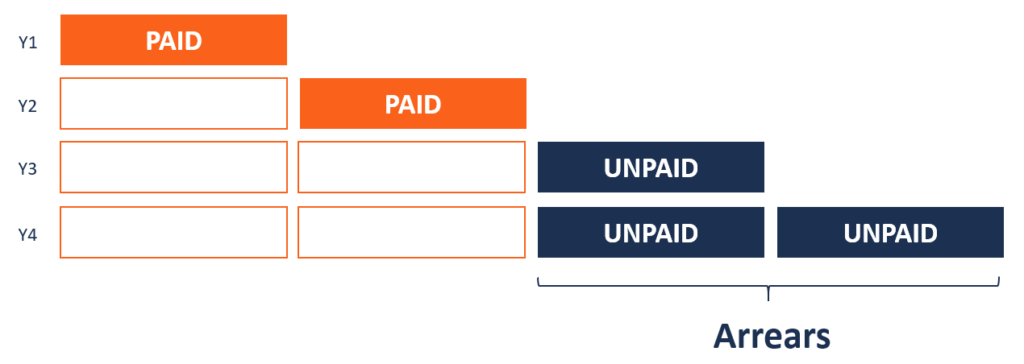
What is Arrears?


Arrears refers to payments that are overdue and that are supposed to be made at the end of a given period after missing out on the required payments. Total arrears equals the sum of all the payments that have accumulated over time since the first payment was due. The term can be used in relation to various costs such as rent payments, water bills, child support, royalties, dividends, loan repayments, etc.


Arrears


An account can also be said to be in arrears if the service has already been rendered, and the payment is due to be made at the end of the agreed period. For example, an employee is paid a salary in arrears because the service must be offered and completed before any payments can be made.

https://corporatefinanceinstitute.com/resources/knowledge/finance/arrears/


AUDIT PLANNING: MEANING, OBJECTIVES, AND IMPORTANCE

📘 AUDIT PLANNING: MEANING, OBJECTIVES, AND IMPORTANCE ✅ Meaning of Audit Planning Audit Planning is the process of developing a compre...