About Me

PhD, NET(UGC), MBA (Finance), M.com (Finance), B.COM (professional), B.Ed (Commerce + English), DIM, PGDIM, PGDIFM, NIIT Accounting package...

Monday, October 26, 2020

House property


1. Basics of House Property

A house property could be your home, an office, a shop, a building or some land attached to the building like a parking lot. The Income Tax Act does not differentiate between a commercial and residential property. All types of properties are taxed under the head ‘income from house property’ in the income tax return. An owner for the purpose of income tax is its legal owner, someone who can exercise the rights of the owner in his own right and not on someone else’s behalf.

When a property is used for the purpose of business or profession or for carrying out freelancing work – it is taxed under the ‘income from business and profession’ head. Expenses on its repair and maintenance are allowed as business expenditure.

a. Self-Occupied House Property

A self-occupied house property is used for one’s own residential purposes. This may be occupied by the taxpayer’s family – parents and/or spouse and children. A vacant house property is considered as self-occupied for the purpose of Income Tax.

Prior to FY 2019-20, if more than one self-occupied house property is owned by the taxpayer, only one is considered and treated as a self-occupied property and the remaining are assumed to be let out. The choice of which property to choose as self-occupied is up to the taxpayer.

For the FY 2019-20 and onwards, the benefit of considering the houses as self-occupied has been extended to 2 houses. Now, a homeowner can claim his 2 properties as self-occupied and remaining house as let out for Income tax purposes.

b.  Let Out House Property

A house property which is rented for the whole or a part of the year is considered a let out house property for income tax purposes

c. Inherited Property

An inherited property i.e. one bequeathed from parents, grandparents etc again, can either be a self occupied one or a let out one based on its usage as discussed above.

 
 2. Steps to Calculate Income From House Property
Here is how you compute your income from a house property:

a. Determine Gross Annual Value (GAV) of the property: The gross annual value of a self-occupied house is zero. For a let out property, it is the rent collected for a house on rent.

b. Reduce Property Tax: Property tax, when paid, is allowed as a deduction from GAV of property.

c. Determine Net Annual Value(NAV) : Net Annual Value = Gross Annual Value – Property Tax

d. Reduce 30% of NAV towards standard deduction: 30% on NAV is allowed as a deduction from the NAV under Section 24 of the Income Tax Act. No other expenses such as painting and repairs can be claimed as tax relief beyond the 30% cap under this section.

e. Reduce home loan interest: Deduction under Section 24 is also available for interest paid during the year on housing loan availed.

f. Determine Income from house property: The resulting value is your income from house property. This is taxed at the slab rate applicable to you.

g. Loss from house property: When you own a self occupied house, since its GAV is Nil, claiming the deduction on home loan interest will result in a loss from house property. This loss can be adjusted against income from other heads.

Note: When a property is let out, its gross annual value is the rental value of the property. The rental value must be higher than or equal to the reasonable rent of the property determined by the municipality.

3. Tax Deduction on Home Loans

a. Tax Deduction on Home Loan Interest: Section 24

Homeowners can claim a deduction of up to Rs 2 lakh on their home loan interest, if the owner or his family resides in the house property. The same treatment applies when the house is vacant. If you have rented out the property, the entire home loan interest is allowed as a deduction.

However, your deduction on interest is limited to Rs. 30,000 instead of Rs 2 lakhs if both the following conditions stand satisfied:

a. The loan is taken on or after 1 April 1999

b. The purchase or construction is not completed within 5 years from the end of the FY in which loan was availed


b. Tax Deduction on Principal Repayment

The deduction to claim principal repayment is available for up to Rs. 1,50,000 within the overall limit of Section 80C.Check the principal repayment amount with your lender or look at your loan installment details.

Conditions to claim this deduction-

  • The home loan must be for purchase or construction of a new house property.
  • The property must not be sold in five years from the time you took possession. Doing so will add back the deduction to your income again in the year you sell.

Stamp duty and registration charges Stamp duty and registration charges and other expenses related directly to the transfer are also allowed as a deduction under Section 80C, subject to a maximum deduction amount of Rs 1.5 lakh. Claim these expenses in the same year you make the payment on them.

c. Tax Deduction for First-Time Homeowners: Section 80EE

Section 80EE recently added to the Income Tax Act provides the homeowners, with only one house property on the date of sanction of loan, a tax benefit of up to Rs 50,000.

Click here to read more.

c. Tax Deduction for First-Time Homeowners: Section 80EEA

A new section 80EEA is added to extend the tax benefits of interest deduction for housing loan taken for affordable housing during the period 1 April 2019 to 31 March 2020. The individual taxpayer should not be entitled to deduction under section 80EE.

Click here to read more. These benefits are not available for an under construction property.

Do you own more than one house?

If you own more than one house, you need to file the ITR-2 form.

Read our guide to ITR-2 form here.

4. Claiming Deduction on Home Loan

  • The amount of deduction you can claim depends on the ownership share you have on the property.

  • The home loan must also be in your name. A co-borrower can claim these deductions too.

  • The home loan deduction can only be claimed from the financial year in which the construction is completed.

  • Submit your home loan interest certificate to your employer for him to adjust tax deductions at source accordingly. This document contains information on your ownership share, borrower details and EMI payments split into interest and principal.

  • Otherwise, you may have to calculate the taxes on your own and claim the refund, if any, at the time of tax filing. It’s also possible that you may have to deposit the dues on your own if there is a tax payable.

  • If you are self-employed or a freelancer, you don’t have to submit these documents anywhere, not even to the IT Department. You will need them to calculate your advance tax liability for every quarter. You must keep them safely to answer queries that may arise from the IT Department and for your own records.

5. Tax Benefits on Home Loans for Joint Owners

The joint owners, who are also co-borrowers of a self-occupied house property, can claim a deduction on interest on the home loan up to Rs 2 lakh each. And deduction on principal repayments, including a deduction for stamp duty and registration charges under Section 80C within the overall limit of Rs.1.5 lakh for each of the joint owners. These deductions are allowed to be claimed in the same ratio as that of the ownership share in the property.

You may have taken the loan jointly, but unless you are an owner in the property – you are not entitled to the tax benefits. There have been situations where the property is owned by a parent and the parent and child together take up a loan which is paid off only by the child. In such a case the child, who is not a co-owner is devoid of the tax benefits on the home loan.

Therefore, to claim the tax benefits on the property:

1. You must be a co-owner in the property

2. You must be a co-borrower for the loan

Each co-owner can claim a deduction of maximum Rs 1.5 lakh towards repayment of principal under section 80C. This is within the overall limit of Rs 1.5 lakh of Section 80C. Therefore, you can avail a larger tax benefit against the interest paid on home loan when the property is jointly owned and your interest outgo exceeds Rs 2 lakh per year.

It’s important to note that the tax benefit of both the deduction on home loan interest and principal repayment under section 80C can only be claimed once the construction of the property is complete.

6.Significant Budget Amendment in 2017 – Impact explained with an example

Till FY 2016-17, loss under the head house property could be set off against other heads of income without any limit. However, form FY 2017-18, such set off of losses has been restricted to Rs 2 lakhs. This amendment would not really affect taxpayers having a self-occupied house property. This move will have an impact on taxpayers who have let-out/ rented their properties. Though there is no bar on the amount of home loan interest that can be claimed as a deduction under Section 24 for a rented house property, the losses which could arise on account of such interest payment can be set off only to the extent of Rs 2 lakhs.

Here is an example to help you comprehend the impact of the amendment:

 
  ParticularsAY 2017-18AY 2018-19
Salary income10,00,00010,00,000
Income from other sources (Interest income)4,00,0004,00,000
Income from house property (*)(4,40,000)(2,00,000)
Gross Total Income9,60,00012,00,000
Deductions2,00,0002,00,000
Taxable income7,60,00010,00,000
Tax on the above77,0001,12,500
Additional tax outgo excluding cess in AY 2018-19 on account of the amendment35,500

Workings for Income from House Property

 ParticularsAY 2017-18AY 2018-19
Property A
Annual ValueNilNil
(-) Interest on housing loan restricted to2,00,0002,00,000
Loss from House Property(A)(2,00,000)(2,00,000)
Property B
Net income from House Property after all deductions (B)60,00060,000
Property C
Annual Value5,00,0005,00,000
Less : Standard Deduction1,50,0001,50,000
Less : Interest on loan6,50,0006,50,000
Loss from House Property (C)(3,00,000)(3,00,000)
Total income from house property (A+B+C)(4,40,000)Restricted to (2,00,000). Balance loss of Rs 2.4 lakhs can be carried forward for the next 8 AYs

Factors that affect foreign direct investment


Factors that affect foreign direct investment (FDI)

Foreign direct investment (FDI) means companies purchase capital and invest in a foreign country. For example, if a US multinational, such as Nike built a factory for making trainers in Pakistan; this would count as foreign direct investment.

In summary, the main factors that affect foreign direct investment are

  • Infrastructure and access to raw materials
  • Communication and transport links.
  • Skills and wage costs of labour

Factors affecting foreign direct investment

factors-affecting-fdi

1. Wage rates

A major incentive for a multinational to invest abroad is to outsource labour-intensive production to countries with lower wages. If average wages in the US are $15 an hour, but $1 an hour in the Indian sub-continent, costs can be reduced by outsourcing production. This is why many Western firms have invested in clothing factories in the Indian sub-continent.

  • However, wage rates alone do not determine FDI, countries with high wage rates can still attract higher tech investment. A firm may be reluctant to invest in Sub-Saharan Africa because low wages are outweighed by other drawbacks, such as lack of infrastructure and transport links.

2. Labour skills

Some industries require higher skilled labour, for example pharmaceuticals and electronics. Therefore, multinationals will invest in those countries with a combination of low wages, but high labour productivity and skills. For example, India has attracted significant investment in call centres, because a high percentage of the population speak English, but wages are low. This makes it an attractive place for outsourcing and therefore attracts investment.

3. Tax rates

Large multinationals, such as Apple, Google and Microsoft have sought to invest in countries with lower corporation tax rates. For example, Ireland has been successful in attracting investment from Google and Microsoft. In fact, it has been controversial because Google has tried to funnel all profits through Ireland, despite having operations in all European countries.

4. Transport and infrastructure

A key factor in the desirability of investment are the transport costs and levels of infrastructure. A country may have low labour costs, but if there is then high transport costs to get the goods onto the world market, this is a drawback. Countries with access to the sea are at an advantage to landlocked countries, who will have higher costs to ship goods.

5. Size of economy / potential for growth

Foreign direct investment is often targeted to selling goods directly to the country involved in attracting the investment. Therefore, the size of the population and scope for economic growth will be important for attracting investment. For example, Eastern European countries, with a large population, e.g. Poland offers scope for new markets. This may attract foreign car firms, e.g. Volkswagen, Fiat to invest and build factories in Poland to sell to the growing consumer class. Small countries may be at a disadvantage because it is not worth investing for a small population. China will be a target for foreign investment as the newly emerging Chinese middle class could have a very strong demand for the goods and services of multinationals.

6. Political stability / property rights

Foreign direct investment has an element of risk. Countries with an uncertain political situation, will be a major disincentive. Also, economic crisis can discourage investment. For example, the recent Russian economic crisis, combined with economic sanctions, will be a major factor to discourage foreign investment. This is one reason why former Communist countries in the East are keen to join the European Union. The EU is seen as a signal of political and economic stability, which encourages foreign investment.

Related to political stability is the level of corruption and trust in institutions, especially judiciary and the extent of law and order.

7. Commodities

One reason for foreign investment is the existence of commodities. This has been a major reason for the growth in FDI within Africa – often by Chinese firms looking for a secure supply of commodities.

8. Exchange rate

A weak exchange rate in the host country can attract more FDI because it will be cheaper for the multinational to purchase assets. However, exchange rate volatility could discourage investment.

9. Clustering effects

Foreign firms often are attracted to invest in similar areas to existing FDI. The reason is that they can benefit from external economies of scale – growth of service industries and transport links. Also, there will be greater confidence to invest in areas with a good track record. Therefore, some countries can create a virtuous cycle of attracting investment and then these initial investments attracting more. It is also sometimes known as an agglomeration effect.

10. Access to free trade areas.

A significant factor for firms investing in Europe is access to EU Single Market, which is a free trade area but also has very low non-tariff barriers because of harmonisation of rules, regulations and free movement of people. For example, UK post-Brexit is likely to be less attractive to FDI, if it is outside the Single Market.

Evaluation

There are many different factors that determine foreign direct investment (FDI) and it is hard to isolate individual factors, given there are many different variables. It also depends on the type of industry. For example, with manufacturing FDI, low wage costs tend to be the most important, as they are a labour-intensive industry. For the service sector, FDI, macro-economic stability and political openness tend to be more important.

Also, it depends on the source of FDI, American firms may value political openness more than Chinese firms. Or American firms may have a preference for countries where English is spoken more.

UK – Post Brexit

If the UK leaves the Single Market, there will be two factors which make the UK less attractive as a place for FDI

  1. Outside Single Market – the possibility of tariffs or greater barriers to trade with rest of Europe. Even if tariffs to EU are low (World trade rules) there is a considerable significance of being outside Single Market which may put off firms, who prefer the security of being in a country committed to Single Market
  2. Access to labour. The UK economy has benefited from migrant labour, e.g. construction sector has a high percentage of Eastern European workers. Without free movement of labour, there may be a greater unwillingness to invest in UK.

On the other hand, the UK may seek to attract inward investment, through the aggressive cutting of corporation tax.

https://www.economicshelp.org/blog/15736/economics/factors-that-affect-foreign-direct-investment-fdi/

Foreign Direct Investment


What Is Foreign Direct Investment (FDI)?

Types of Foreign Direct Investment

Introduction

In this article, we will see what is Foreign Direct Investment (FDI), what are the types and methods of FDI. In the current economic environment, there are no isolated economies anymore. All countries now function on a global level. And hence we have a strong global economy, where there are very few barriers to the flow of goods and money. This opens up avenues for international investments as well.

What Is Foreign Direct Investment (FDI)?

  • Foreign direct investment (FDI) is an investment made by a company or individual in one country in business interests in another country. FDI is done in the form of either establishing business operations or acquiring business assets in the other country, such as ownership or controlling interest in a foreign company.
  • FDIs are different from foreign portfolio investments (FPIs) in which an investor merely purchases and passively holds the equities of foreign-based companies.
  • These investments are commonly made in open economies that offer a skilled workforce and above-average growth prospects for the investor, as opposed to tightly regulated economies.
  • Foreign direct investment usually involves more than just a capital investment. It may include provisions of management or technology as well.
Lasting Interest and the Element of Control

1. Lasting Interest : An investment into a foreign firm is considered an FDI if it establishes a lasting interest. A lasting interest is established when an investor obtains at least 10% of the voting power in the firm.

2. Element of Control : The key to foreign direct investment is the element of control. Control represents the intent to actively manage and influence a foreign firm’s operations. This is the major differentiating factor between FDI and a passive foreign portfolio investment. Thus, key feature of FDI is that it is an investment made that establishes either effective control of, or at least substantial influence over, the decision making of a foreign business.

3. For this reason, a 10% stake in the foreign company’s voting stock is necessary to define FDI.

4. The Flow of FDI : The amount of FDI undertaken over a period.

  • Outflow of FDI are the flows of FDI out of a country
  • Inflow of FDI are the flows of FDI into a country
Types of Foreign Direct Investment

Types of Foreign Direct Investment

Foreign direct investments have 4 types as being Horizontal, Vertical, Conglomerate and Platform FDI.

A. Horizontal Investments :
  • A horizontal direct investment refers to the investor establishing the same type of business operation in a foreign country as it operates in its home country.
  • Thus, horizontal FDI occure when the multinational firm undertakes the same production activities in multiple countries.
  • Example : Apple based in the United States opens stores in India that would be called horizontal investment. Also, Coke, Pepsi, Samsung, HSBC etc expanded internationally by way of horizontal FDI.

B. Vertical Investments :
  • A vertical investment is one in which different but related business activities from the investor’s main business are established or acquired in a foreign country.
  • Vertical FDI takes place when the multinational fragments the production process internationally, locating each stage of production in a country with the least cost.
  • Therer are 2 types of Vertical FDIs : Forward Vertical FDI & Backward Vertical FDI
  1. Forward Vertical FDI : In this, the FDI brings the company nearer to a market. For example, Toyota buying a car distributorship in America.
  2. Backward Vertical FDI : In this, the international integration goes back towards raw materials. For example, Toyota getting majority stake in a tyre manufacturer or a rubber plantation.
C. Conglomerate Investments :
  • A conglomerate type of foreign direct investment is one where a company or individual makes a foreign investment in a business that is unrelated to its existing business in its home country.
  • Thus, in conglomerate investments, a business acquires an unrelated business in a foreign country. This is uncommon as it requires overcoming two barriers to entry: entering a foreign country and entering a new industry or market. 
Platform FDI
Platform FDI
D. Platform FDI :
  • In a Platform type of FDI, a business expands into a foreign country but the output from the foreign operations is exported to a third country. This is also referred to as Export-Platform FDI.
  • Platform FDI commonly happens in low-cost locations inside free-trade areas.
  • For example, if Ford purchased manufacturing plants in Ireland with the primary purpose of exporting cars to other countries in the EU.

Methods of Foreign Direct Investment

FDI also have categorization based on how it enters the other country:

  1. Subsidiary or Associate Company : One way to enter another countries market is through setting up a subsidiary in other country. That would help in getting access to other country market and use its resources for e.g., affiliate and subsidiary banks are the most popular setups for foreign market entry.
  2. Merger or Acquisition : Another way to enter a country is by merger. For e.g., Sun pharma acquisition of Ranbaxy.
  3. Greenfield Investment : FDI is made in new/upcoming facilities. They are the main area of interest for the host nation as it boosts expansion, economy, jobs and technological advances. Eg. Walmart opening retail stores in India.
https://blog.investyadnya.in/what-is-foreign-direct-investment-fdi/

foreign investment

 Foreign investment refers to the investment in domestic companies and assets of another country by a foreign investor. Large multinational corporations will seek new opportunities for economic growth by opening branches and expanding their investments in other countries.

types-of-fdi-india

Following sectors are prohibited for FI:

I. Lottery Business

II. Gambling and betting

III. The business of chit fund

IV. Nidhi Company

V. Trading in transferable development rights (TDRs)

VI. Manufacturing of cigars, cheroots, cigarillos and cigarettes, tobacco or its substitutes

VII. Atomic Energy

VIII. Railways Operation

Types of Foreign Investment in India

Any investment that is made in India with the source of funding that is from outside of India is a foreign investment. By this definition, the investments that are made by Foreign Corporates, Foreign Nationals, as well as Non-Resident Indians would fall into the category of Foreign Investment.

Types of Foreign Investments

Funds from foreign country could be invested in shares, properties, ownership / management or collaboration. Based on this, Foreign Investments are classified as below.

  • Foreign Direct Investment (FDI)
  • Foreign Portfolio Investment (FPI)
  • Foreign Institutional Investment (FII)

Details on each of the foreign investment type can be found below :

Foreign Direct Investment (FDI)

FDI is an investment made by a company or individual who us an entity in one country, in the form of controlling ownership in business interests in another country. FDI could be in the form of either establishing business operations or by entering into joint ventures by mergers and acquisitions, building new facilities etc.

Here are the different types of foreign investments

1. Horizontal FDI

The most common type of FDI is Horizontal FDI, which primarily revolves around investing funds in a foreign company belonging to the same industry as that owned or operated by the FDI investor. Here, a company invests in another company located in a different country, wherein both the companies are producing similar goods. For example, the Spain-based company Zara may invest in or purchase the Indian company Fab India, which also produces similar products as Zara does. Since both the companies belong to the same industry of merchandise and apparel, the FDI is classified as horizontal FDI.

2. Vertical FDI

Vertical FDI is another type of foreign investment. A vertical FDI occurs when an investment is made within a typical supply chain in a company, which may or may not necessarily belong to the same industry. As such, when vertical FDI happens, a business invests in an overseas firm which may supply or sell products. Vertical FDIs are further categorised as backward vertical integrations and forward vertical integrations. For instance, the Swiss Coffee producer Nescafe may invest in coffee plantations in countries such as Brazil, Columbia, Vietnam, etc. Since the investing firm purchases, a supplier in the supply chain, this type of FDI is known as backward vertical integration. Conversely, forward vertical integration is said to occur when a company invests in another foreign company which is ranked higher in the supply chain, for instance, a coffee company in India may wish to invest in a French grocery brand.

3. Conglomerate FDI

When investments are made in two completely different companies of entirely different industries, the transaction is known as conglomerate FDI. As such, the FDI is not linked directly to the investors business. For instance, the US retailer Walmart may invest in TATA Motors, the Indian automobile manufacturer.

4. Platform FDI

The last types of foreign direct investment is platform FDI. In the case of platform FDI, a business expands into a foreign country, but the products manufactured are exported to another, third country. For instance, the French perfume brand Chanel set up a manufacturing plant in the USA and export products to other countries in America, Asia, and other parts of Europe.

If you intend to invest via FDI, you must know about the different types of FDI with examples. With FDI, the money invested can be used to start a new business in a foreign country or to invest in an already existing business in a foreign country. For more information on FDIs, consult Angel Broking advisors.

Foreign Portfolio Investment (FPI)

Foreign Portfolio Investment (FPI) is an investment by foreign entities and non-residents in Indian securities including shares, government bonds, corporate bonds, convertible securities, infrastructure securities etc.  The intention is to ensure a controlling interest in India at an investment that is lower than FDI, with flexibility for entry and exit.

Foreign Institutional Investment (FII)

Foreign Portfolio Investment (FPI) is an investment by foreign entities in securities, real property and other investment assets. Investors include mutual fund companies, hedge fund companies etc. The intention is not to take controlling interest, but to diversify portfolio ensuring hedging and to gain high returns with quick entry and exit.

The differences in FPI and FII are mostly in the type of investors and hence the terms FPI and FII are used interchangeably.

The Securities Market in India is regulated by Securities and Exchange Board of India (SEBI). Refer to the article on SEBI to get more information on this topic.

Types of FII

There are different types of FIIs operating in India. A wide variety of foreign institutions can be categorised as FIIs in India. Here is a list of foreign institutional types investing in India.  

– Pension funds

– Mutual Funds

– Investment trusts

– Banks

– Sovereign Wealth Funds

– Asset Management Company

– Insurance/Reinsurance Companies

– Foreign Central Banks

– Foreign Government Agencies

– Endowments

– Foundations

– University Funds

– Charitable Trusts

Foreign individuals can also invest in Indian markets by registering as sub-accounts of FIIs. While there are different types of FIIs, the government has streamlined the process of investment to make it easier for FIIs to access financial markets in India. To invest in Indian securities, FIIS have to register with the Securities and Exchange Board of India and invest through a registered broker and a recognised stock exchange. Different types of foreign institutional investors can invest in shares or convertible debentures through private placement or offer for sale. FIIs are also allowed to issue Offshore Derivative Instruments to entities regulated by a foreign regulatory authority. The sub-accounts/FIIs have to appoint a local custodian for the Indian securities. The domestic custodian holds the securities in its custody. The local custodian is registered and monitored by the markets regulator. FIIs/subaccounts have to ensure that the local custodian monitors its investments and reports all the transactions at regular intervals.


Consumer Adoption Process


Consumer Adoption Process (5 Stages)

DIFFUSION OF INNOVATION

https://nptel.ac.in/content/storage2/courses/110105029/pdf%20sahany/module%208l40.pdf

Diffusion of Innovation

 What is Diffusion of Innovation?

Diffusion of Innovation (DOI) is a theory popularized by American communication theorist and sociologist, Everett Rogers, in 1962 that aims to explain how, why, and the rate at which a product, service, or process spreads through a population or social system. In other words, the diffusion of innovation explains the rate at which new ideas and technology spread. The diffusion of innovation theory is used extensively by marketers to understand the rate at which consumers are likely to adopt a new product or service.


Rationale Behind the Diffusion of Innovation

The adoption of a new product, service, or idea is not an overnight phenomenon – it does not happen simultaneously across all people in a social system. According to research, consumers who adopt an innovation earlier demonstrate different characteristics than someone who adopts an innovation later. Therefore, for marketers, understanding the characteristics of each segment that will either help or hinder the adoption of an innovation is important.

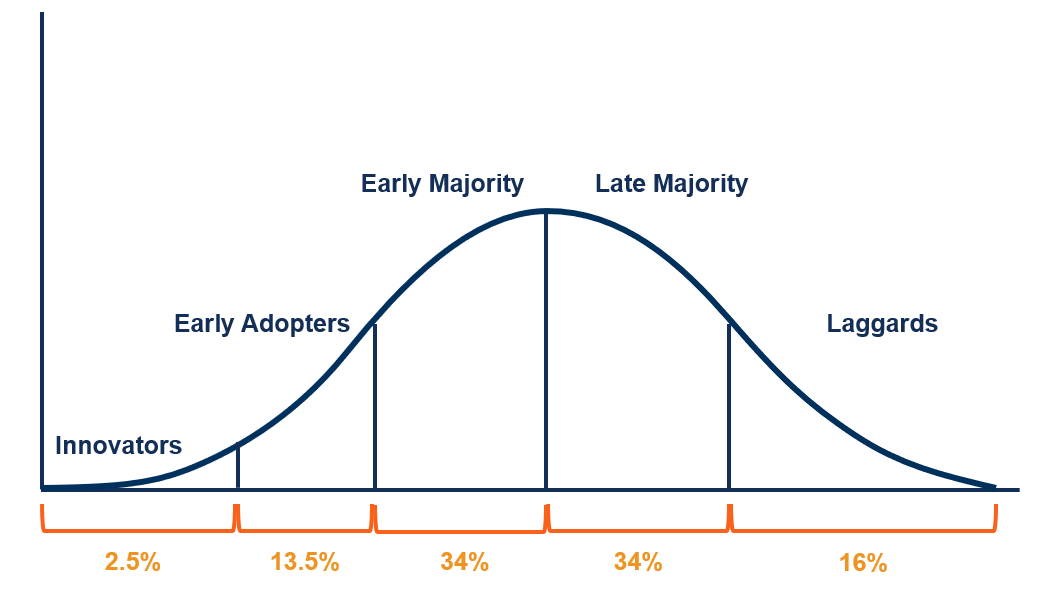
In the diffusion of innovation theory, there are five adopter categories:

  1. Innovators: Characterized by those who want to be the first to try the innovation.
  2. Early Adopters: Characterized by those who are comfortable with change and adopting new ideas.
  3. Early Majority: Characterized by those who adopt new innovations before the average person. However, evidence is needed that the innovation works before this category will adopt the innovation.
  4. Late Majority: Characterized by those who are skeptical of change and will only adopt an innovation after it’s been generally accepted and adopted by the majority of the population.
  5. Laggards: Characterized by those who are very traditional and conservative – they are the last to make the changeover to new technologies. This category is the hardest to appeal to.


Rogers provides the distribution of the five adopter categories as follows: Innovators represent the first 2.5% of the group to adopt an innovation, followed by 13.5% as early adopters, 34% as early majorities, 34% as late majorities, and finally,16% as laggards. Note that the size of the laggards category is much larger than that of the innovators category on the opposite end of the spectrum.


Diffusion of Innovation - Distribution Chart


Diffusion of Innovation: Innovators

Innovators are those who want to be the first to acquire a new product or service. They are risk-takers, price-insensitive, and are able to cope with a high degree of uncertainty. Innovators are crucial to the success of any new product or service, as they help it to gain market acceptance.

For example, individuals who stay overnight outside a movie theatre to be the first to purchase the first showing to a movie are considered innovators.


Diffusion of Innovation: Early Adopters

Early adopters are those who are not quite as risk-taking as innovators and typically wait until the product or service receives some reviews before making a purchase. Early adopters are referred to as “influencers” or “opinion leaders”, and are often regarded as role models within their social system. They are key in helping the spread of a product or service achieve “critical mass”.

Therefore, if early adopters of a product or service are small, the total number of people who adopt the product or service will likely be small as well. Individuals who wait a couple of days and spend some time reading reviews before going to see a movie are regarded as early adopters.


Diffusion of Innovation: Early Majority

Early majorities represent the majority of the market – 34%. Early majorities are not risk-taking and typically wait until a product or service is tested or used by a trusted peer. These individuals are prudent and want to purchase things that are proven to work.

Individuals who go to a movie after it’s been out several weeks and gotten good reviews and made profits at the box office are early majorities.


Diffusion of Innovation: Late Majority

Late majorities also represent an important percentage of the market – 34%. Late majorities are the last large group of consumers to enter the market. They are deemed conservative and are often technologically shy, very cost-sensitive, skeptical, and cautious in making a purchase. In addition, late majorities are often peer pressured into purchasing the product or service.

People who wait for a movie to become available online or on Netflix are regarded as late majorities.


Diffusion of Innovation: Laggards

Laggards are the last to adopt a new product or service. They resent change and may continue to rely on traditional products or services until they are no longer available. In other words, they typically only adopt the new technology when virtually forced to.

Laggards perhaps finally catch a hit movie when it’s shown on network TV.


Importance of the Diffusion of Innovation

The diffusion of innovation theory explains the rate at which consumers will adopt a new product or service. Therefore, the theory helps marketers understand how trends occur, and helps companies in assessing the likelihood of success or failure of their new introduction. By utilizing the diffusion of innovation theory, firms can predict which types of consumers will purchase their product/service and create effective marketing strategies to push acceptance through each category.


for more visit

https://corporatefinanceinstitute.com/resources/knowledge/other/diffusion-of-innovation/

AUDIT PLANNING: MEANING, OBJECTIVES, AND IMPORTANCE

📘 AUDIT PLANNING: MEANING, OBJECTIVES, AND IMPORTANCE ✅ Meaning of Audit Planning Audit Planning is the process of developing a compre...